Monday, 25 December 2023

Wednesday, 6 December 2023
life cycle of a thread notes
A thread life cycle is always in one of these five states. It can move from one state to another state. In Java, the life cycle of thread has five states.
1. Newborn State
2. Runnable State
3. Running State
4. Blocked State
5. Dead State
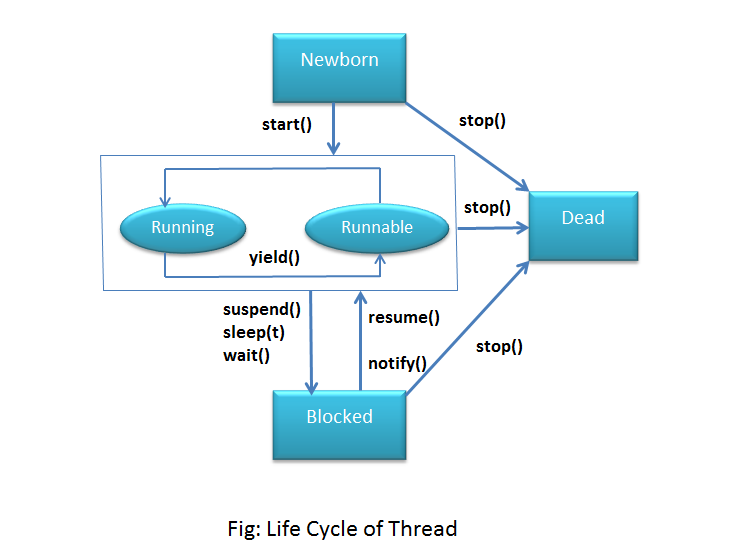
New : A thread begins its life cycle in the new state. It remains in this state until the start() method is called on it.
Thread t = new Thread();Runnable : After invocation of start() method on new thread, the thread becomes runnable.
Thread t = new Thread();
t.start();Running : A thread is in running state if the thread scheduler has selected it.
t1.isAlive() - The isAlive() method returns true if the thread upon which it is called is still running otherwise it returns false.
Waiting : A thread is in waiting state if it waits for another thread to perform a task. In this stage the thread is still alive.
Example1: t1.join() waiting for t1 to complete its execution
Example2: The state of thread t1 after invoking the method sleep() on it - TIMED_WAITING
Thread.sleep(400);
Terminated : A thread enters the terminated state when it completes its task.
t1.stop()
Tuesday, 28 November 2023
Deadlock Recovery
deadlock recovery techniques like wound-wait and wait-die are used to handle situations where processes are waiting for resources, and a deadlock might occur. Let's break them down:
Wound-Wait:
Think of it like being a bit impatient. If a process needs a resource held by another process, it checks the age or "wound" of the other process.
If the other process is "younger" (started later), then the current process waits.
If the other process is "older" (started earlier), the current process can "wound" it, meaning it can force the older process to release its resources, preventing a deadlock.
Wait-Die:
This approach is more patient. If a process needs a resource held by another process, it checks the age or "age difference" between them.
If the other process is "younger," the current process waits.
If the other process is "older," the current process can "die," meaning it gives up and gets restarted, allowing the older process to continue and preventing a deadlock.
In both cases, the idea is to avoid deadlocks by carefully managing how processes interact.
Sunday, 26 November 2023
Factor analysis, Dimensionality reduction, Predictive analytics, Cluster Analysis, Decision Tree, Types of Decision Trees notes
Factor analysis: in factor analysis, latent variables are turned into factors i.e, they are reduced according to their functionality
Example waiting time, cleanliness, healthy and taste are latent variables
waiting time, cleanliness are service factors
healthy and taste are food experience factor
In a hotel or restaurant these latent variables are reduced to factors.
Descriptive analysis is very important in the sense of model building
Merits of factor analysis:
1. reduces amount of data
2. easy categorization
3. uses statistical methods
4. very important in model building
5. data is very easy to interpret as there are no outliers
6. is important descriptive analysis technique
Predictive analytics: is when we retrieve the unknown or future data with the help of past/current data
There are 4 types of predictive analysis
1. classification
2. Prediction
3. Regression
4. Time series
These types are used in different situations accordingly
Dimensionality reduction: when there is data with high dimensionality working with it becomes difficult and tedious task.
to remove this we perform data reduction step in KDD process
Dimensionality reduction is a part of data reduction
Some dimensionality reduction:
1. Data cube: data is arranged in cube form to ensure there are less dimensions
2. Numerosity: we can apply rank to groups of data
3. Feature selection: we need to find appropriate features using filtering, morphing etc
4. Normalization: to make all the data in same range or interval
Lazy Learning: Lazy learning is a technique where we give a model some rules and testing criteria. But it only executes them when the data is given to them or from their neighbours
if we give data suppose a=2 and b=3 then only it learns from the formula otherwise it wont
it is useful when we have TB of data and we cant test all of it.
kNN is a lazy learning algorithm
Cluster Analysis
Cluster analysis is a kind of descriptive analysis where we group or cluster similar kind of data.
it is helpful for large amounts of unstructured data
it is used to further analysis and building models
Although there are different types of cluster analysis but the most popular ones are
1. partitioning clusters
2. hierarchical
3. Density Based
4. Grid Based
1. Partitioning Methods: as the name suggest partitioning methods involves partitioning a data set and performing some analysis or methods or formulas to derive the cluster.
K- means and K- medoids are Partitioning methods
2. Hierarchical Methods: As the name suggests we need to form a hierarchy and then we can form one cluster.
Agglomerative and Divisive are popular hierarchical methods
3. Density Methods: When we assign some density to the data points and combine them by their density. DBScan is one of the popular density based clustering technique
4. Grid Based: in this method, we assign the density to the cluster and then store them in the form of a rectangular grid with cells
Then we apply decision tree and apply levels
Higher level cells are stored in one cluster and lower level in one
In cluster analysis, we need to choose the appropriate cluster technique for the datasets
Decision Tree: Here in this below example,
weather is root node
humidity and speed are attributes/ columns
yes or no are class labels
This example shows if a child can play outside or not.
In decision tree, rectangle represents attributes/ columns
ellipse represents class labels
The main purpose of decision tree is to extract the rules for classification.
Example: if weather = sunny and humidity = normal then play = yes
if weather = cloudy then play = yes
id weather = windy and speed = low then play = yes
Types of Decision Trees
1) un weighted decision tree: when there is no weight on any nodes of the decision tree, i.e, there are no biases in decision tree
2. weighted decision tree:
3. binary decision tree: where there are only two attributes or labels in a tree
4. Random forest: n number of decision trees combined
Functions and Files in python
Function is used to run a block of code
Syntax:
def function_name(arguments):
statements
return
def - declaration of the function
function_name: it refers to the name of the function
arguments: values passed to the function
statement - block of code to run program
return - it is used to return the value. It is sometimes used and sometimes not used
Note: once return is executed, it is end of the function
Function call: We can call the function by using function name. once the function is called the execution takes place to the definition of the function.
Syntax: def greet()
def greet():
statements
#calling the function
greet()
Example:
def add_numbers(a=8, b=6):
sum = a+b
print(sum)
#call the function
add_numbers(2,3)
Ouput:
5
Files in Python
There are different operations on file
1. creating a file: fp = open('file.txt', 'w') or fp = open('file.txt', 'a')
2. opening a file : fp = open('file.txt', 'w') or fp = open('file.txt', 'a') or fp = open('file.txt', 'r')
3. reading fp = open('file.txt', 'r')
4. writing to file fp = open('file.txt', 'w')
5. closing the file fp.close()
6. appending to a file fp = open('file.txt', 'a')
Big Data Analytics notes
Big data is large amount of complex data which is increasing rapidly. This data can be of any type and this data is inconsistent in nature. This data cannot be processed through traditional methods.
Characteristics of Big data
There are four main characteristics of big data
1) volume: big data can be very large
2) variety: big data can be of any data type
3) veracity: big data can be inconsistent at times
4) velocity: the speed at which big data is generated is fast
Importance of big data
in todays generation with 8 billion population, big data plays an important role.
1) In business, big data can generate meaningful insights through big data tools to increase customer satisfaction.
Ex: if there is an company, it can use big data to analyze customer behavior and recommend relevant products.
2) Big data also plays an important role in science
large number of test can be analyzed very effectively using big data
3)Personal use: big data can also be useful to us
Ex: like in Spotify , we have each persons yearly recap, where it shows what kind of music, we listened to in that year.
Applications of Big Data
Big data is used and applied in almost every sector now - a- days.
This can be made possible through tools like hadoop.
Some of the applications of big data are
1) In hospitals, to manage large amount of patients
2) in business, to bring out meaningful insights
3) in education institutions to evaluate student performance
4) in social media
5) search engine
6) online shopping
7) in scientific research
Data sources: are those sources from which we can acquire big data
internal data source: these sources use sensor technologies and are commonly used in organizations i.e, these sources collect data from their devices, collects data like audio, video, temperature
Ex: mobile phones, IoT devices
third party data sources: where there is any small business that do not have enough money or inventory to have internal data sources, they go for third party data sourcing i.e, they source data using third party technology.
It is commonly seen in small web pages
It collects the data like no. of clicks, opens
Example: google analytics
External data source: these data sources are collected by different source and they are open to be accessed by anyone Ex: social media
Open data sources: these are similar to external sources but open data sources are very complex and are not relevant for us. These can be scientific data or research data or government data
Ex: www.govt.uk
Through these sources we can acquire big data.
Sturctured vs unstructured
Structured : These are in tabular format.
Can be interpreted through machines
easy to analyze and can done through both machines and humands
can use tools like SQL, Oracle
Unstructured: These are in video, audio, image format
can be difficult to interpret through machine
difficult to analyze and can be done through only humans
tools like noSQL, hadoop
PIG architecture
here are 4 main parts of pig
1) parser: it performs semantic checks and checks the syntax in pig scripts. After checking, it converts the pig script to DAG and logical operation format. The parser sends this DAG file to optimizer.
2) optimizer: it takes the DAG input from the parser and applies some functions like projection and push down to delete unnecessary columns. It also optimizes the logical plan of the script. After that it send this optimized DAG file to compiler.
3) compiler: Here, compiler takes optimized DAG file and compiles it. The output of compiler gives a series of map reduce jobs as multi- querying is available in pig compiler. Pig compiler can rearrange the order to execute efficiently
4) execution engine: it takes the final compiled map reduce tasks and executes it.
The other components are
i) Grunt shell: it is like command line interface like pig
ii) Apache pig: where all the libraries are stored
iii) map reduce: where mapping and reducing is done
iv) finally HDFS: where map reduce output is stored.
Hive Architecture
process of hive architecture is similar to apache pig
hive server: hive server takes all the requests from the drivers and serves and sends them to hive driver.
hive driver: hive driver compiles and optimizes the queries that are in DAG format outputs and sends them to execution engine as map reduce task
execution engine: it executes all the map reduce jobs
meta store: it stores all the information about the data present in Hive. It stores meta data about the columns and its information. it serializes and desterilizes data
CLI: Hive command line interface
Hive web UI: It is GUI commonly provided online
Hive Client:
1)Trift Server: it connects all programming languages that support thrift to HIVE
2)JDBC driver: as hive is built on top of map reduce and use java. it connects to java for application purposes
3) ODBC driver: application that connects to HIVE which supports ODBC