Tuesday, 26 March 2024

Wednesday, 13 March 2024
REFRESHER COURSE IN COMPUTER SCIENCE YOUTUBE LINKS
CLOUD
https://www.youtube.com/watch?v=M-13NVkTTzM
https://www.youtube.com/watch?v=Qb6L9i2b0sk
https://www.youtube.com/watch?v=5q7-Rf9y2lQ
https://drive.google.com/file/d/1Et39IY48XjLHmSRPQxIe1ghBuSkZVkVc/view
https://www.youtube.com/watch?v=eEQg_m_lXVo
AUGMENTED REALITY :
https://www.youtube.com/watch?v=3oOSYfMDVFM&t=3s
https://www.youtube.com/watch?v=gVB97H_VP5s
nlp
https://www.youtube.com/watch?v=0NkSPJUBwJo
https://www.youtube.com/watch?v=3IAmlWhpWtc
https://www.youtube.com/watch?v=w17hhPAXdas
IOT:
https://www.youtube.com/watch?v=YR1zKl6tnrM
ml
https://www.youtube.com/watch?v=eZDAZcXPJ0U
https://www.youtube.com/watch?v=q14CQPkxdt4
https://www.youtube.com/watch?v=VCDb0MHTM7Y
https://www.youtube.com/watch?v=omeEjvwjh3g
https://www.youtube.com/watch?v=fSpXmdTHNZs
BLOCK CHAIN
https://www.youtube.com/watch?v=dBOeXgi_JFk
QUANTING COMPUTING
https://www.youtube.com/watch?v=T8NebqqHLW0
CYBER PANDEMIC
https://www.youtube.com/watch?v=qA9Sg9DWdgA
https://www.youtube.com/watch?v=i97bw12FkRE
Monday, 25 December 2023
Wednesday, 6 December 2023
life cycle of a thread notes
A thread life cycle is always in one of these five states. It can move from one state to another state. In Java, the life cycle of thread has five states.
1. Newborn State
2. Runnable State
3. Running State
4. Blocked State
5. Dead State
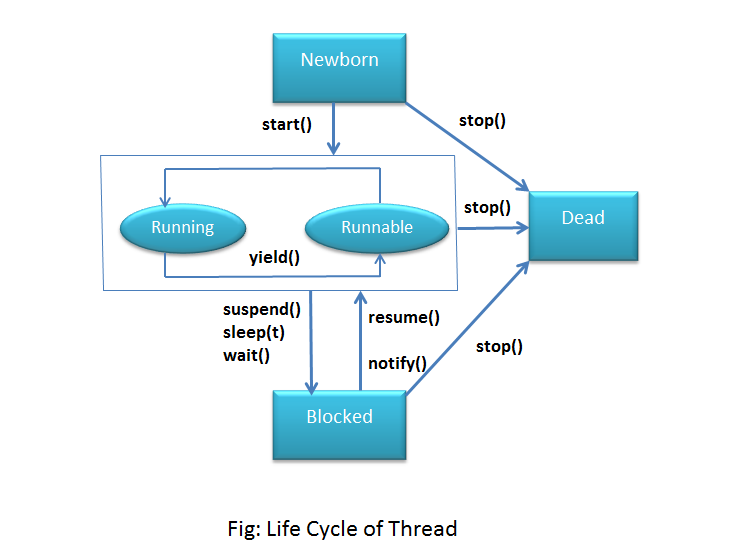
New : A thread begins its life cycle in the new state. It remains in this state until the start() method is called on it.
Thread t = new Thread();Runnable : After invocation of start() method on new thread, the thread becomes runnable.
Thread t = new Thread();
t.start();Running : A thread is in running state if the thread scheduler has selected it.
t1.isAlive() - The isAlive() method returns true if the thread upon which it is called is still running otherwise it returns false.
Waiting : A thread is in waiting state if it waits for another thread to perform a task. In this stage the thread is still alive.
Example1: t1.join() waiting for t1 to complete its execution
Example2: The state of thread t1 after invoking the method sleep() on it - TIMED_WAITING
Thread.sleep(400);
Terminated : A thread enters the terminated state when it completes its task.
t1.stop()
Tuesday, 28 November 2023
Deadlock Recovery
deadlock recovery techniques like wound-wait and wait-die are used to handle situations where processes are waiting for resources, and a deadlock might occur. Let's break them down:
Wound-Wait:
Think of it like being a bit impatient. If a process needs a resource held by another process, it checks the age or "wound" of the other process.
If the other process is "younger" (started later), then the current process waits.
If the other process is "older" (started earlier), the current process can "wound" it, meaning it can force the older process to release its resources, preventing a deadlock.
Wait-Die:
This approach is more patient. If a process needs a resource held by another process, it checks the age or "age difference" between them.
If the other process is "younger," the current process waits.
If the other process is "older," the current process can "die," meaning it gives up and gets restarted, allowing the older process to continue and preventing a deadlock.
In both cases, the idea is to avoid deadlocks by carefully managing how processes interact.
Sunday, 26 November 2023
Factor analysis, Dimensionality reduction, Predictive analytics, Cluster Analysis, Decision Tree, Types of Decision Trees notes
Factor analysis: in factor analysis, latent variables are turned into factors i.e, they are reduced according to their functionality
Example waiting time, cleanliness, healthy and taste are latent variables
waiting time, cleanliness are service factors
healthy and taste are food experience factor
In a hotel or restaurant these latent variables are reduced to factors.
Descriptive analysis is very important in the sense of model building
Merits of factor analysis:
1. reduces amount of data
2. easy categorization
3. uses statistical methods
4. very important in model building
5. data is very easy to interpret as there are no outliers
6. is important descriptive analysis technique
Predictive analytics: is when we retrieve the unknown or future data with the help of past/current data
There are 4 types of predictive analysis
1. classification
2. Prediction
3. Regression
4. Time series
These types are used in different situations accordingly
Dimensionality reduction: when there is data with high dimensionality working with it becomes difficult and tedious task.
to remove this we perform data reduction step in KDD process
Dimensionality reduction is a part of data reduction
Some dimensionality reduction:
1. Data cube: data is arranged in cube form to ensure there are less dimensions
2. Numerosity: we can apply rank to groups of data
3. Feature selection: we need to find appropriate features using filtering, morphing etc
4. Normalization: to make all the data in same range or interval
Lazy Learning: Lazy learning is a technique where we give a model some rules and testing criteria. But it only executes them when the data is given to them or from their neighbours
if we give data suppose a=2 and b=3 then only it learns from the formula otherwise it wont
it is useful when we have TB of data and we cant test all of it.
kNN is a lazy learning algorithm
Cluster Analysis
Cluster analysis is a kind of descriptive analysis where we group or cluster similar kind of data.
it is helpful for large amounts of unstructured data
it is used to further analysis and building models
Although there are different types of cluster analysis but the most popular ones are
1. partitioning clusters
2. hierarchical
3. Density Based
4. Grid Based
1. Partitioning Methods: as the name suggest partitioning methods involves partitioning a data set and performing some analysis or methods or formulas to derive the cluster.
K- means and K- medoids are Partitioning methods
2. Hierarchical Methods: As the name suggests we need to form a hierarchy and then we can form one cluster.
Agglomerative and Divisive are popular hierarchical methods
3. Density Methods: When we assign some density to the data points and combine them by their density. DBScan is one of the popular density based clustering technique
4. Grid Based: in this method, we assign the density to the cluster and then store them in the form of a rectangular grid with cells
Then we apply decision tree and apply levels
Higher level cells are stored in one cluster and lower level in one
In cluster analysis, we need to choose the appropriate cluster technique for the datasets
Decision Tree: Here in this below example,
weather is root node
humidity and speed are attributes/ columns
yes or no are class labels
This example shows if a child can play outside or not.
In decision tree, rectangle represents attributes/ columns
ellipse represents class labels
The main purpose of decision tree is to extract the rules for classification.
Example: if weather = sunny and humidity = normal then play = yes
if weather = cloudy then play = yes
id weather = windy and speed = low then play = yes
Types of Decision Trees
1) un weighted decision tree: when there is no weight on any nodes of the decision tree, i.e, there are no biases in decision tree
2. weighted decision tree:
3. binary decision tree: where there are only two attributes or labels in a tree
4. Random forest: n number of decision trees combined